|
COMETS EARTH JUPITER KUIPER BELT MARS MERCURY METEORITES NEPTUNE OORT CLOUD PLUTO SATURN SOLAR SYSTEM SPACE SUN URANUS VENUS ORDER PRINTS
PHOTO CATEGORIES SCIENCEVIEWS AMERICAN INDIAN AMPHIBIANS BIRDS BUGS FINE ART FOSSILS THE ISLANDS HISTORICAL PHOTOS MAMMALS OTHER PARKS PLANTS RELIGIOUS REPTILES SCIENCEVIEWS PRINTS
|
 |
Related Documents
Download Options
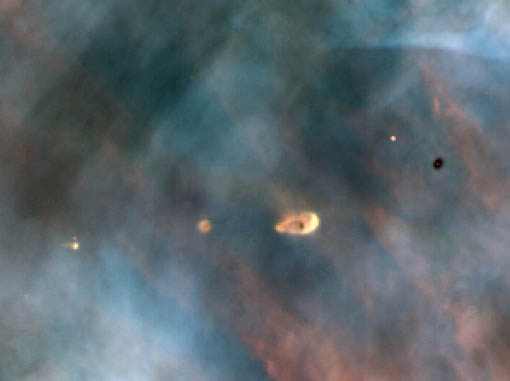
A Hubble Space Telescope view of a small portion of the Orion Nebula reveals five young stars. Four of the stars are surrounded by gas and dust trapped as the stars formed, but were left in orbit about the star. These are possibly protoplanetary disks, or "proplyds," that might evolve on to agglomerate planets. The proplyds which are closest to the hottest stars of the parent star cluster are seen as bright objects, while the object farthest from the hottest stars is seen as a dark object. The field of view is only 0.14 light-years across. The Orion Nebula star-birth region is 1,500 light-years away, in the direction of the constellation Orion the Hunter. |