|
COMETS EARTH JUPITER KUIPER BELT MARS MERCURY METEORITES NEPTUNE OORT CLOUD PLUTO SATURN SOLAR SYSTEM SPACE SUN URANUS VENUS ORDER PRINTS
PHOTO CATEGORIES SCIENCEVIEWS AMERICAN INDIAN AMPHIBIANS BIRDS BUGS FINE ART FOSSILS THE ISLANDS HISTORICAL PHOTOS MAMMALS OTHER PARKS PLANTS RELIGIOUS REPTILES SCIENCEVIEWS PRINTS
|
 |
Related Document
Download Options
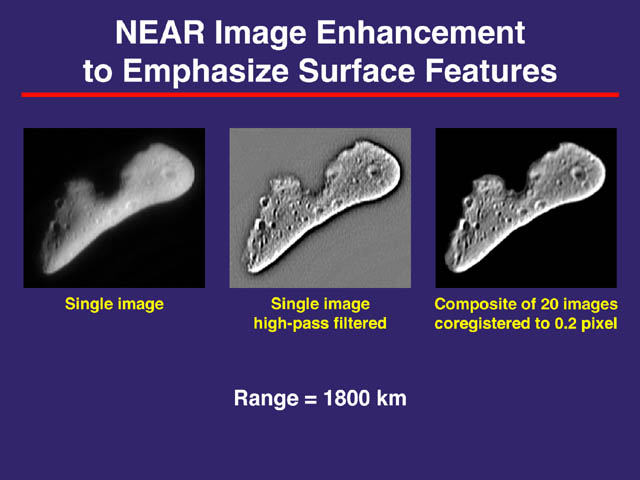
The NEAR camera's ability to show details of Eros's surface is limited by the spacecraft's distance from the asteroid. That is, the closer the spacecraft is to the surface, the more that details are visible. However mission scientists regularly use computer processing to squeeze an extra measure of information from returned data. In a technique known as "superresolution", many images of the same scene acquired at very, very slightly different camera pointing are carefully overlain and processed to bright out details even smaller than would normally be visible. In this rendition constructed out of 20 image frames acquired Feb. 12, 2000, the images have first been enhanced ("high-pass filtered") to accentuate small-scale details. Superresolution was then used to bring out features below the normal ability of the camera to resolve. (Mosaic of images 0125957025 and 0125957087) |