|
COMETS EARTH JUPITER KUIPER BELT MARS MERCURY METEORITES NEPTUNE OORT CLOUD PLUTO SATURN SOLAR SYSTEM SPACE SUN URANUS VENUS ORDER PRINTS
PHOTO CATEGORIES SCIENCEVIEWS AMERICAN INDIAN AMPHIBIANS BIRDS BUGS FINE ART FOSSILS THE ISLANDS HISTORICAL PHOTOS MAMMALS OTHER PARKS PLANTS RELIGIOUS REPTILES SCIENCEVIEWS PRINTS
|
 |
Related Document
Download Options
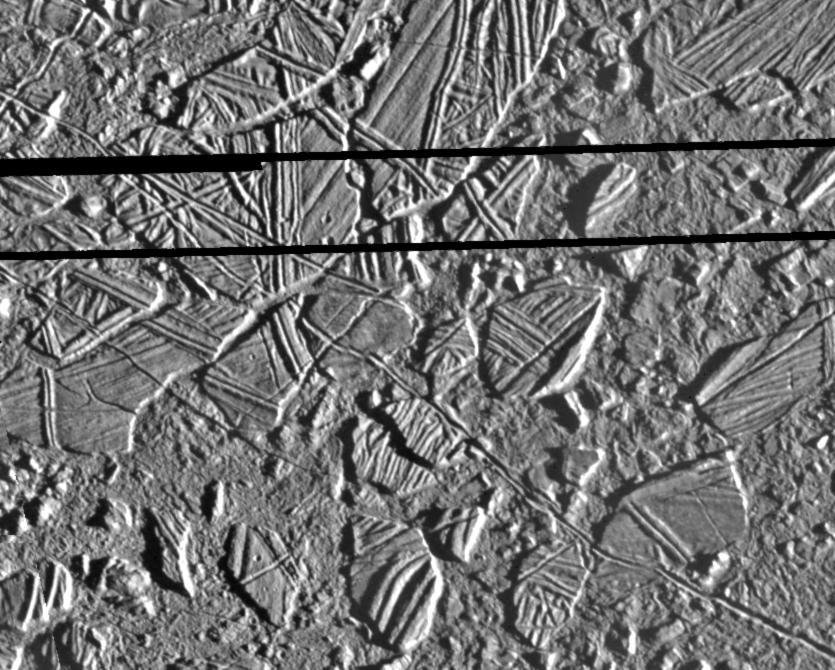
This high resolution image shows the ice-rich crust of Europa, one of the moons of Jupiter. Seen here are crustal plates ranging up to 13 kilometers (8 miles) across, which have been broken apart and "rafted" into new positions, superficially resembling the disruption of pack-ice on polar seas during spring thaws on Earth. The size and geometry of these features suggest that motion was enabled by ice-crusted water or soft ice close to the surface at the time of disruption. The area shown is about 34 kilometers by 42 kilometers (21 miles by 26 miles), centered at 9.4 degrees north latitude, 274 degrees west longitude, and the resolution is 54 meters (59 yards). This picture was taken by the Solid State Imaging system on board the Galileo spacecraft on February 20, 1997, from a distance of 5,340 kilometers (3,320 miles) during the spacecraft's close flyby of Europa. |