|
COMETS EARTH JUPITER KUIPER BELT MARS MERCURY METEORITES NEPTUNE OORT CLOUD PLUTO SATURN SOLAR SYSTEM SPACE SUN URANUS VENUS ORDER PRINTS
PHOTO CATEGORIES SCIENCEVIEWS AMERICAN INDIAN AMPHIBIANS BIRDS BUGS FINE ART FOSSILS THE ISLANDS HISTORICAL PHOTOS MAMMALS OTHER PARKS PLANTS RELIGIOUS REPTILES SCIENCEVIEWS PRINTS
|
 |
Related Documents
Download Options
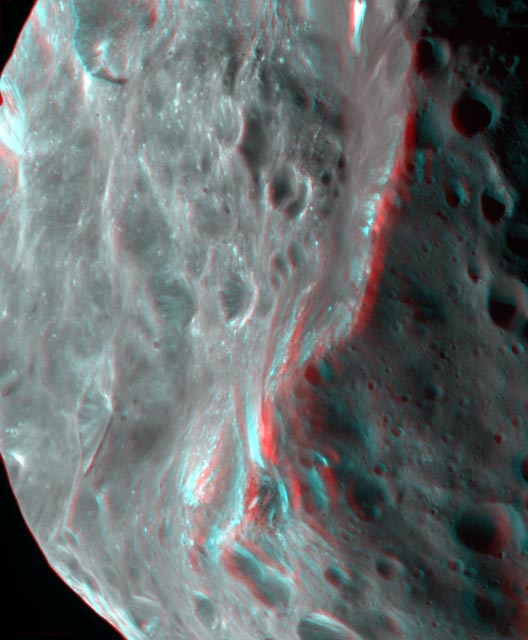
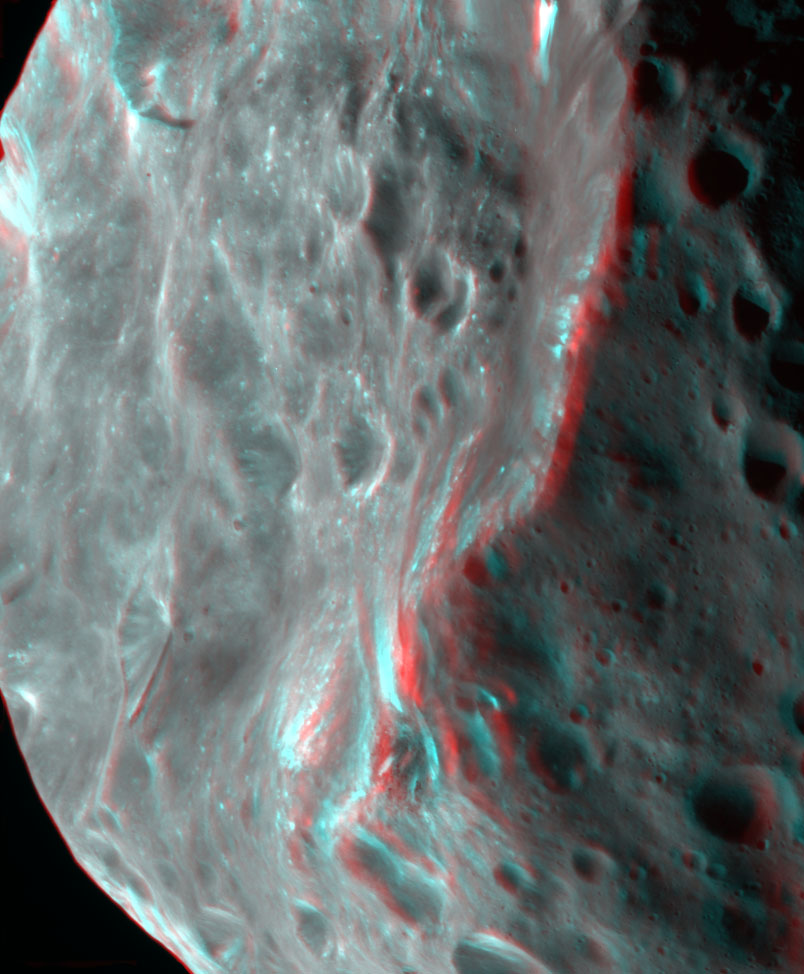
Phoebe's violent, cratered past is more evident in this 3-D image of the tiny moon. The Sun is coming from the left, illuminating craters and bumps on the surface, along with a prominent ridge-like feature in the middle. Bright material, likely to be ice, is exposed atop this ridge-like feature as well as around small craters and down the slopes of large craters. There are also bright streaks on steep slopes, perhaps where loose material slid downhill during the seismic shaking of impact events. This 3-D mosaic is made up of two images taken with the Cassini spacecraft narrow angle camera on June 11, 2004. The right image was taken from a range of 15,215 kilometers (9,454 miles) to the surface of Phoebe, through a clear filter. The left image was taken from a range of 20,085 kilometers (12,480 miles) to the surface of Phoebe, through clear and infrared filters. The image scale ranges from 92 meters (301.8 feet) per pixel (right image) to 482 meters (1,581 feet) per pixel (left image). The left image has been altered to match the right image here. |