|
COMETS EARTH JUPITER KUIPER BELT MARS MERCURY METEORITES NEPTUNE OORT CLOUD PLUTO SATURN SOLAR SYSTEM SPACE SUN URANUS VENUS ORDER PRINTS
PHOTO CATEGORIES SCIENCEVIEWS AMERICAN INDIAN AMPHIBIANS BIRDS BUGS FINE ART FOSSILS THE ISLANDS HISTORICAL PHOTOS MAMMALS OTHER PARKS PLANTS RELIGIOUS REPTILES SCIENCEVIEWS PRINTS
|
 |
Related Documents
Download Options
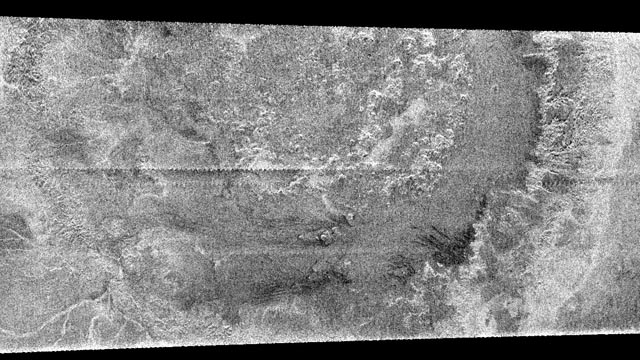
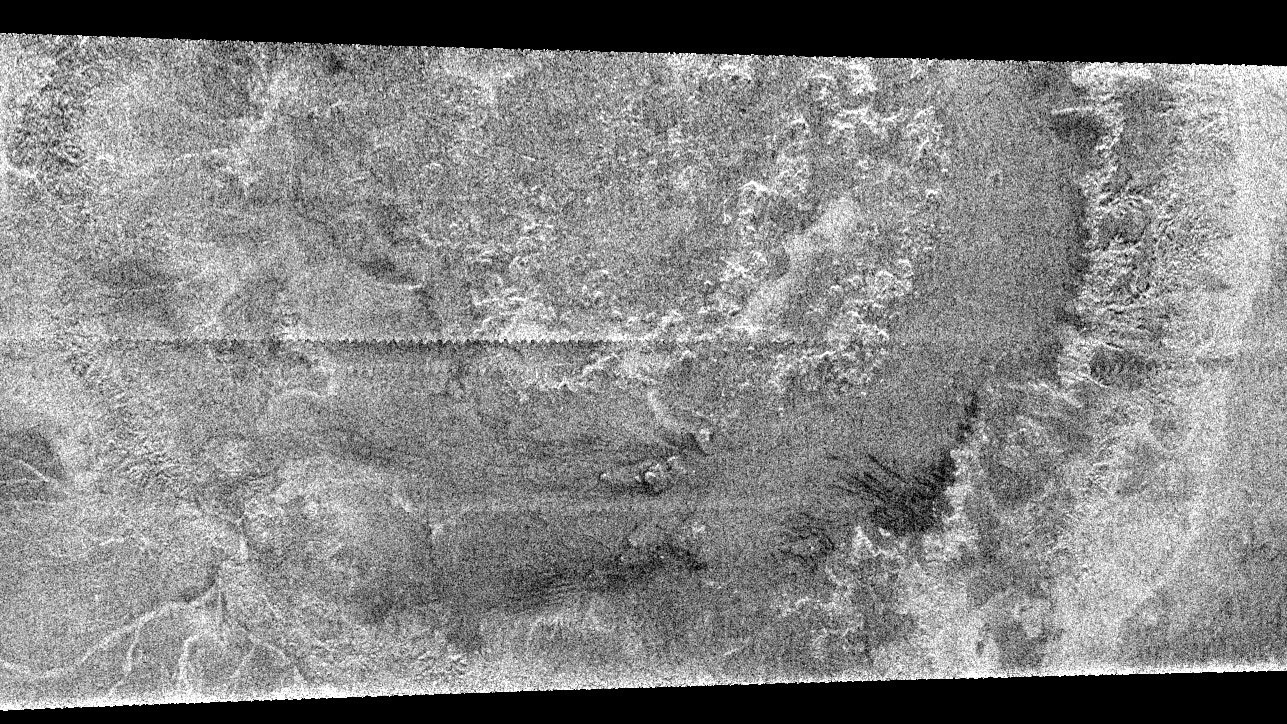
A huge annular feature with an outer diameter of approximately 440 kilometers (273 miles) appears in this image taken with Cassini's Titan radar mapper. It resembles a large crater or part of a ringed basin, either of which could be formed when a comet or asteroid tens of kilometers in size slammed into Titan. This is the first impact feature identified in radar images of Titan. The surface of Titan appears to be very young compared to other Saturnian satellites. In Titan's case, debris raining down from the atmosphere or other geologic processes may mask or remove the craters. The pattern of brightness suggests that there is topography associated with this feature; for example, in the center of the image there appear to be mounds each about 25 kilometers (15 miles) across. Since they are dark on their lower edges that face away from the radar and bright on the opposite face, they must be elevated above the surrounding terrain. This image is a part of a larger swath acquired on Feb. 15, 2005, on Cassini's second opportunity to map Titan's surface via radar. Seams between radar segments are visible as horizontal, sawtooth-shaped lines. |