|
COMETS EARTH JUPITER KUIPER BELT MARS MERCURY METEORITES NEPTUNE OORT CLOUD PLUTO SATURN SOLAR SYSTEM SPACE SUN URANUS VENUS ORDER PRINTS
PHOTO CATEGORIES SCIENCEVIEWS AMERICAN INDIAN AMPHIBIANS BIRDS BUGS FINE ART FOSSILS THE ISLANDS HISTORICAL PHOTOS MAMMALS OTHER PARKS PLANTS RELIGIOUS REPTILES SCIENCEVIEWS PRINTS
|
 |
Related Documents
Download Options
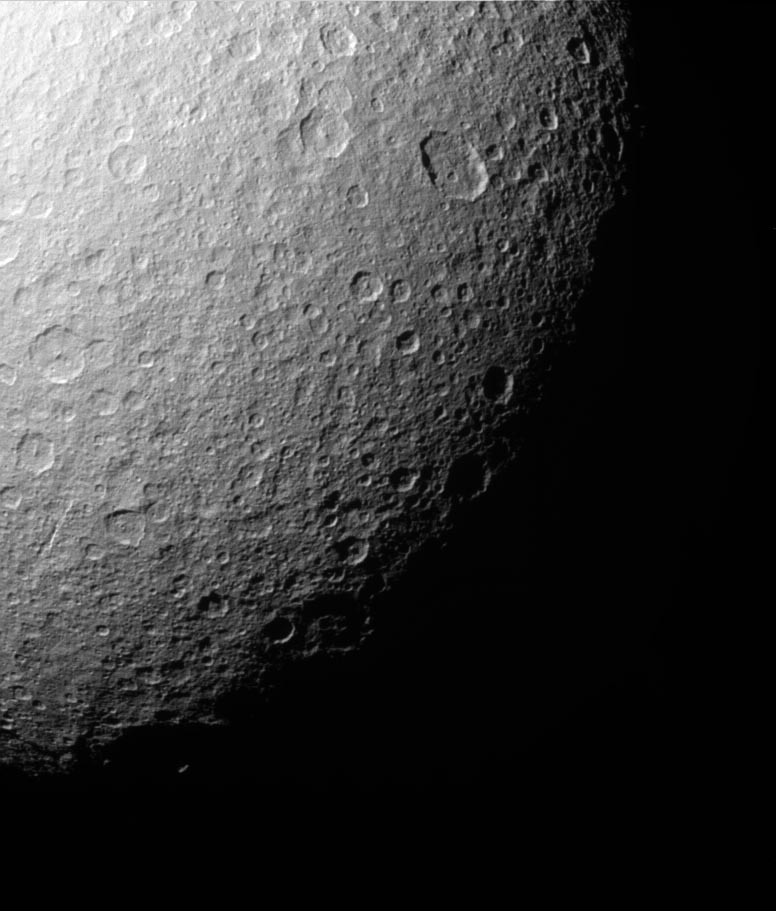
Like the rest of Rhea's surface, the southern polar region of this Saturn moon has been extensively re-worked by cratering over the eons. This close-up shows that most sizeable craters have smaller, younger impact sites within them. Near the left lies an intriguing gash. The largest well-defined crater visible here is an oval-shaped impact toward the upper right. The crater is 115 by 91 kilometers (71 by 57 miles) in size. Cassini acquired this view during a distant flyby of Rhea (1,528 kilometers, or 949 miles across) on July 14, 2005. The image was taken in visible light with the Cassini spacecraft narrow-angle camera at a distance of approximately 239,000 kilometers (149,000 miles) from Rhea and at a Sun-Rhea-spacecraft, or phase, angle of 56 degrees. The image was obtained using a filter sensitive to wavelengths of infrared light centered at 930 nanometers. The image scale is about 1 kilometer (0.6 miles) per pixel. |