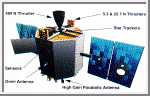
Courtesy of the Naval Research Laboratory, National Space Science Data Center, and Lawrence Livermore National Laboratory
The Clementine mission was undertaken by the Department of Defense to test new technologies for defense and cilivian applications. The spacecraft was launched on January 25, 1994, and then began mapping the Moon. It left lunar orbit on May 3, 1994, after having taken 1.8 million images of the surface. Clementine headed for a flyby of asteroid 1620 Geographos, but the spacecraft suffered a failure that prevented it from obtaining images of this world.
Clementine was one of the first of the new "faster, better, cheaper" planetary missions that use light-weight components, advanced technology, and rapid manufacturing techniques. The spacecraft incorporated a new type of spacecraft design and experimental instrumentation. The program took less than two years from initial concept to launch, far less than larger probes such as Galileo and Cassini.
Clementine had five different imaging systems on-board. The UV/Visible camera had a filter wheel with six different filters, ranging from 415 nm to 1000 nm, and including a broad-band filter covering 400 to 950 nm. The Near Infrared camera also had a six-filter wheel, ranging from 1100 nm to 2690 nm. The Longwave Infrared camera had a wavelength range of 8000 to 9500 nm. The Hi-Res imager had a broad-band filter from 400 to 800 nm and four other filters ranging from 415 to 750 nm. The Star Tracker camera was also used for imaging.
The program was undertaken by the Ballistic Missile Defence Organization (BMDO) with the assistance of NASA. The Lawrence Livermore National Laboratory provided light-weight imaging instruments.

 Space History