Uranus IV
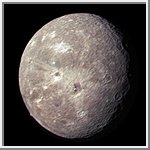
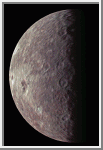
Oberon [O-buh-ron] is a moon of Uranus that is characterized by an old, heavily cratered, and icy surface. The surface shows little evidence of internal activity other than some unknown dark material that apparently covers the floors of many craters. The above image shows several large impact craters towards the center of the image. On the limb, a high mountain rises 6 kilometers (4 miles) above its surroundings. There are bright rays similar to those seen on Jupiter's moon Callisto.
| Oberon Statistics | |
|---|---|
| Discovered by | William Herschel |
| Date of discovery | 1787 |
| Mass (kg) | 3.03e+21 |
| Mass (Earth = 1) | 5.0703e-04 |
| Equatorial radius (km) | 761.4 |
| Equatorial radius (Earth = 1) | 1.1938e-01 |
| Mean density (gm/cm^3) | 1.64 |
| Mean distance from Uranus (km) | 582,600 |
| Rotational period (days) | 13.46324 |
| Orbital period (days) | 13.46324 |
| Mean orbital velocity (km/sec) | 3.15 |
| Orbital eccentricity | 0.0008 |
| Orbital inclination (degrees) | 0.10 |
| Escape velocity (km/sec) | 0.729 |
| Visual geometric albedo | 0.24 |
| Magnitude (Vo) | 13.94 |
Oberon In Color
This image of Oberon shows several large impact craters towards the
center of the picture. Many of the crater floors are covered by an
unknown dark material. On the bottom-left limb,
a high mountain rises 6 kilometers (4 miles) above its surroundings.
Bright rays similar to those seen on Jupiter's
moon Callisto, can be found on Oberon's surface.
(Copyright Calvin J. Hamilton)
 Oberon
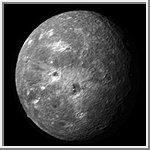
This is the highest resolution image of Oberon taken by the
Voyager 2 spacecraft. It was acquired
on on January 24, 1986, from a distance of 660,000 kilometers.
(Copyright Calvin J. Hamilton)
 Polar Stereographic Map of Oberon
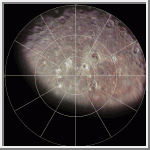
This image is a polar stereographic map of Oberon. The 0° longitude
is at the top in the map.
(Courtesy A. Tayfun Oner)
 Mercator Map of Oberon
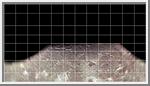
This image is a mercator map of Oberon. The map covers
from 70 to -70 degrees latitude with 0 degree longitude located at the
center. The scale is 5 pixel/degrees at the equator.
(Courtesy A. Tayfun Oner)
 Color Image of Oberon
This image is a reprojected view of Oberon using the above map.
(Courtesy A. Tayfun Oner)

 Uranus
 Titania