|
COMETS EARTH JUPITER KUIPER BELT MARS MERCURY METEORITES NEPTUNE OORT CLOUD PLUTO SATURN SOLAR SYSTEM SPACE SUN URANUS VENUS ORDER PRINTS
PHOTO CATEGORIES SCIENCEVIEWS AMERICAN INDIAN AMPHIBIANS BIRDS BUGS FINE ART FOSSILS THE ISLANDS HISTORICAL PHOTOS MAMMALS OTHER PARKS PLANTS RELIGIOUS REPTILES SCIENCEVIEWS PRINTS
|
 |
Related Documents
Download Options
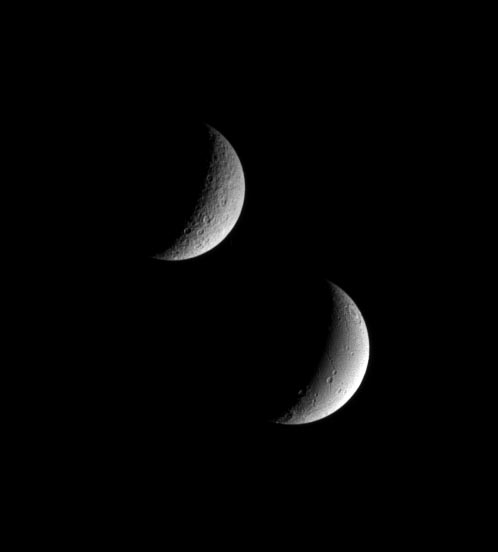
Saturn's sibling moons, Rhea and Dione, pose for the Cassini spacecraft in this view. Even at this distance, it is easy to see that Dione (below) appears to have been geologically active in the more recent past, compared to Rhea (above). Dione's smoother surface and linear depressions mark a contrast with Rhea's cratered terrain. Sunlit terrain seen on Rhea (1,528 kilometers, or 949 miles across) is on the moon's Saturn-facing hemisphere. Lit terrain on Dione (1,126 kilometers, or 700 miles across) is on that moon's leading hemisphere. North is up. The image was taken in visible light with the Cassini spacecraft narrow-angle camera on November 1, 2005, at a distance of approximately 1.8 million kilometers (1.1 million miles) from Rhea and 1.2 million kilometers (800,000 miles) from Dione. The image scale is 11 kilometers (7 miles) per pixel on Rhea and 7 kilometers (4 miles) per pixel on Dione. |