|
COMETS EARTH JUPITER KUIPER BELT MARS MERCURY METEORITES NEPTUNE OORT CLOUD PLUTO SATURN SOLAR SYSTEM SPACE SUN URANUS VENUS ORDER PRINTS
PHOTO CATEGORIES SCIENCEVIEWS AMERICAN INDIAN AMPHIBIANS BIRDS BUGS FINE ART FOSSILS THE ISLANDS HISTORICAL PHOTOS MAMMALS OTHER PARKS PLANTS RELIGIOUS REPTILES SCIENCEVIEWS PRINTS
|
 |
Related Documents
Download Options
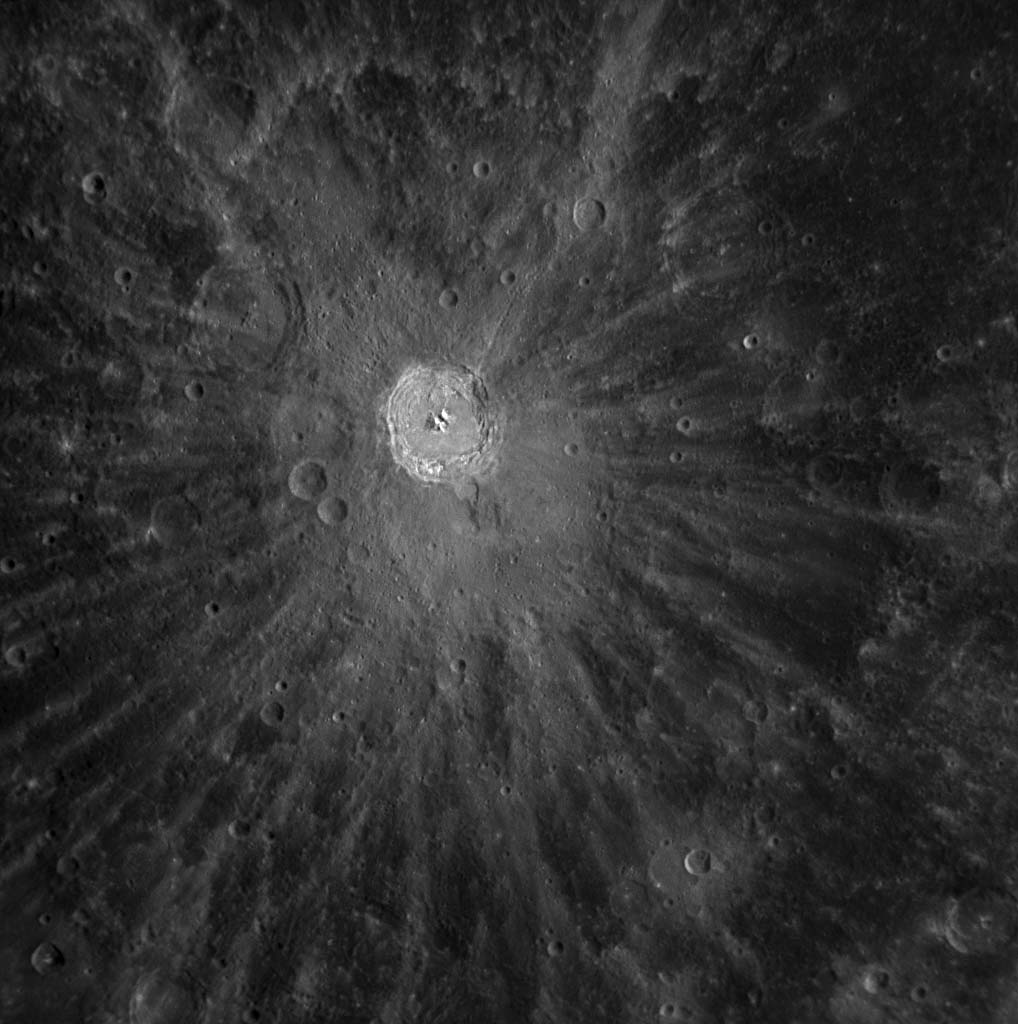
Date Acquired: October 6, 2008 During Monday's flyby of Mercury, MESSENGER's NAC captured a new view of the bright, radial ejecta rays of Kuiper crater that were previously imaged by Mariner 10 at a lower Sun angle. Kuiper crater is named for Gerard Kuiper, a Dutch-American astronomer who was also a member of the Mariner 10 team. Bright ejecta rays such as these are produced as impacts excavate and eject relatively unweathered subsurface material. The ejecta rays of Kuiper and other large craters are observed to extend for hundreds of kilometers across the cratered terrain of Mercury, as seen on the full planet image from MESSENGER's Wide Angle Camera (WAC) released previously. Credit: NASA/Johns Hopkins University Applied Physics Laboratory/Carnegie Institution of Washington |