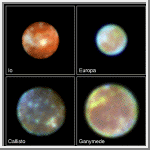
Courtesy of: NASA/JPL
Probably the most significent contribution that Galileo Galilei made to science was the discovery of the four satellites around Jupiter that are now named in his honor. Galileo first observed the moons of Jupiter on January 7, 1610 through a homemade telescope. He originally thought he saw three stars near Jupiter, strung out in a line through the planet. The next evening, these stars seemed to have moved the wrong way, which caught his attention. Galileo continued to observe the stars and Jupiter for the next week. On January 11, a fourth star (which would later turn out to be Ganymede) appeared. After a week, Galileo had observed that the four stars never left the vicinity of Jupiter and appeared to be carried along with the planet, and that they changed their position with respect to each other and Jupiter. Finally, Galileo determined that what he was observing were not stars, but planetary bodies that were in orbit around Jupiter. This discovery provided evidence in support of the Copernican system and showed that everything did not revolve around the Earth.
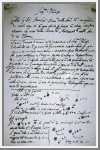
| Galileo's Observations of Jupiter's Moons | |
 |
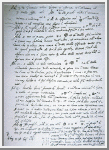 |
Galileo published his observations in Sidereus Nuncius in March 1610:
"I therefore concluded, and decided unhesitatingly, that there are three stars in the heavens moving about Jupiter, as Venus and Mercury around the Sun; which was at length established as clear as daylight by numerous other subsequent observations. These observations also established that there are not only three, but four, erratic sidereal bodies performing their revolutions around Jupiter."
Simon Marius claimed to have observed Jupiter's moon as early as late November 1609 (about five weeks prior to Galileo) and had begun recording his observations in January 1610 at about the same time Galileo was first making his observations. However, since Marius did not publish his observations right away as Galileo had done, his claims were impossible to verify. Since Galileo's work was more reliable and extensive, he is generally given the credit for discovering the moons of Jupiter. In 1614, Marius did provide the names of the Jupiter's moons that we are familiar with today, based on a suggestion from Johannes Kepler:
"This fancy, and the particular names given, were suggested to me by Kepler, Imperial Astronomer, when we met at Ratisbon fair in October 1613. So if, as a jest, and in memory of our friendship then begun, I hail him as joint father of these four stars, again I shall not be doing wrong."
Galileo originally called the Jupiter's moons the "Medicean planets", after the Medici family and referred to the individual moons numerically as I, II, III and IV. Galileo's naming system would be used for a couple of centuries. It wouldn't be until the mid-1800's that the names of the Galilean moons: Io, Europa, Ganymede and Callisto, would be officially adopted, and only after it became very apparent that naming moons by number would be very confusing as new additional moons were being discovered.

 Jupiter