Neptune VIII - 1989N1
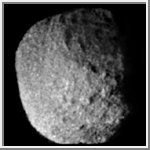
Proteus [PROH-tee-us], like all six of Neptune's newly discovered small satellites, is one of the darkest objects in the solar system -- "as dark as soot" is not too strong of a description. Like Saturn's satellite, Phoebe, it reflects only 6 percent of the sunlight that strikes it. Proteus is about 400 kilometers (250 miles) in diameter, larger than Nereid. It wasn't discovered from Earth because it is so close to Neptune that it is lost in the glare of reflected sunlight. Proteus circles Neptune at a distance of about 92,800 kilometers (57,700 miles) above the cloud tops, and completes one orbit in 26 hours, 54 minutes. Scientists say it is about as large as a satellite can be without being pulled into a spherical shape by its own gravity. Proteus is irregularly shaped and shows no sign of any geological modification. It circles the planet in the same direction as Neptune rotates, and remains close to Neptune's equatorial plane.
| Proteus Statistics | |
|---|---|
| Discovered by | Stephen Synnott |
| Date of discovery | 1989 |
| Mass (kg) | ? |
| Equatorial radius (km) | 200 |
| Equatorial radius (Earth = 1) | 3.1358e-02 |
| Mean density (gm/cm^3) | ? |
| Mean distance from Neptune (km) | 117,600 |
| Rotational period (days) | ? |
| Orbital period (days) | 1.122315 |
| Mean orbital velocity (km/sec) | 7.63 |
| Orbital eccentricity | 0.0004 |
| Orbital inclination (degrees) | 0.04 |
| Visual geometric albedo | 0.06 |
| Magnitude (Vo) | 20.3 |
Proteus
This image of Proteus was acquired by the Voyager 2 spacecraft on
August 25, 1989 from a range of 146,000 kilometers (91,000 miles).
The resolution is about 1.35 kilometers (.85 miles) per pixel.
The satellite, seen here about half illuminated, has an average
radius of 200 kilometers (120 miles). It is dark (albedo 6
percent) and spectrally grey. Hints of crater-like forms and
groove-like lineations can be discerned. The apparent graininess
of the image is caused by the short exposure necessary to avoid
significant smear.
(Copyright Calvin J. Hamilton)
 Topographic Map of Proteus
This is a topographic map of Proteus. It is based upon the shape model of Phil
Stooke. As with all maps, it is the cartographer's interpretation;
not all features are necessarily certain given the limited data
available. This interpretation stretches the data as far as possible.
(Courtesy A. Tayfun Oner)
 Shaded Relief Map of Proteus
This image is a shaded relief map of Proteus, a small inner satellite
of Neptune. As with all maps, it is the cartographer's interpretation
and not all features are necessarily certain given the limited data
available. This interpretation stretches the data as far as is feasible.
(Courtesy Phil Stooke)
 Simple Cylindrical Map of Proteus
This image is a shaded relief map of Proteus, a small inner satellite
of Neptune. As with all maps, it is the cartographer's interpretation
and not all features are necessarily certain given the limited data
available. This interpretation stretches the data as far as is feasible.
This map is similar to the above map but was reprojected to the
Simple Cylindrical projection. As with all cylindrical projections,
this map is severely distorted near the poles (top and bottom edges).
(Courtesy Phil Stooke)

 Neptune
 Larissa
 Triton