|
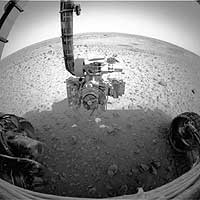
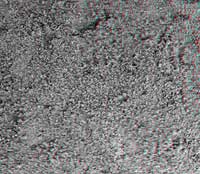
Spirit Flexes Its Arm to Use Microscope on Mars' Soil(January 16, 2004)NASA's Spirit rover reached out with its versatile robotic arm early today and examined a patch of fine-grained martian soil with a microscope at the end of the arm. "We made our first use of the arm and took the first microscopic image of the surface of another planet," said Dr. Mark Adler, Spirit mission manager at NASA's Jet Propulsion Laboratory, Pasadena, Calif. The rover's microscopic imager, one of four tools on a turret at the end of the arm, serves as the functional equivalent of a field geologist's hand lens for examining structural details of rocks and soils. "I'm elated and relieved at how well things are going. We got some great images in our first day of using the microscopic imager on Mars," said Dr. Ken Herkenhoff of the U.S. Geological Survey Astrogeology Team, Flagstaff, Ariz. Herkenhoff is the lead scientist for the microscopic imagers on Spirit and on Spirit's twin Mars Exploration Rover, Opportunity. The microscope can show features as small as the width of a human hair. While analysis of today's images from the instrument has barely begun, Herkenhoff said his first impression is that some of the tiny particles appear to be stuck together. Before driving to a selected rock early next week, Spirit will rotate the turret of tools to use two spectrometer instruments this weekend on the same patch of soil examined by the microsope, said Jessica Collisson, mission flight director. The Mössbauer Spectrometer identifies types of iron-bearing minerals. The Alpha Particle X-ray Spectrometer identifies the elements in rocks and soils. The rover's arm is about the same size as a human arm, with comparable shoulder, elbow and wrist joints. It is "one of the most dextrous and capable robotic devices ever flown in space," said JPL's Dr. Eric Baumgartner, lead engineer for the robotic arm, which also goes by the name "instrument deployment device." "Best of all," Baumgartner said, "this robotic arm sits on a rover, and a rover is meant to rove. Spirit will take this arm and the tremendous science package along with it, and reach out to investigate the surface." The wheels Spirit travels on provide other ways to examine Mars' soil. Details visible in images of the wheel tracks from the rover's first drive onto the soil give information about the soil's physical properties. "Rover tracks are great," said Dr. Rob Sullivan of Cornell University, Ithaca, N.Y., a member of the science team for Spirit and Opportunity. "For one thing, they mean we're on the surface of Mars! We look at them for engineering reasons and for science reasons." The first tracks show that the wheels did not sink too deep for driving and that the soil has very small particles that provide a finely detailed imprint of the wheels, he said. Opportunity, equipped identically to Spirit, will arrive at Mars January 25 (Universal Time and EST; 9:05 p.m. January 24, PST). The amount of dust in the atmosphere over Opportunity's planned landing site has been declining in recent days, said JPL's Dr. Joy Crisp, project scientist for the Mars Exploration Rover Project. Today, Spirit completes its 13th martian day, or "sol", at its landing site in Gusev Crater. Each sol lasts 39 minutes and 35 seconds longer than an Earth day. The rover project's goal is for Spirit and Opportunity to explore the areas around their landing sites for clues in the rocks and the soil about whether the past environments there were ever watery and possibly suitable for sustaining life. |