|
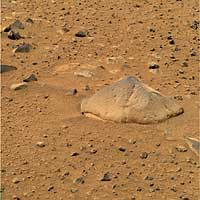
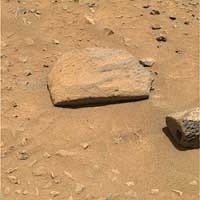
Spirit Drives to a Rock Called 'Adirondack' for Close Inspection(January 19, 2004)The Mars Exploration Rover flight team at NASA's Jet Propulsion Laboratory, Pasadena, Calif., plans to send commands to Spirit early Tuesday to examine Adirondack with a microscope and two instruments that reveal the composition of rocks, said JPL's Dr. Mark Adler, Spirit mission manager. The instruments are the Mössbauer spectrometer and the alpha particle X-ray spectrometer. Spirit successfully rolled off the lander and onto the martian surface last Thursday. To make the drive to Adirondack, the rover turned 40 degrees in short arcs totaling 95 centimeters (3.1 feet). It then turned in place to face the target rock and drove four short moves straightforward totaling 1.9 meters (6.2 feet). The moves covered a span of 30 minutes on Sunday, though most of that was sitting still and taking pictures between moves. The total amount of time when Spirit was actually moving was about two minutes. "These are the sorts of baby steps we're taking," said JPL's Dr. Eddie Tunstel, rover mobility engineer. "The drive was designed for two purposes, one of which was to get to the rock," Tunstel said. "From the mobility engineers' standpoint, this drive was geared to testing out how we do drives on this new surface." Gathering new information such as how much the wheels slip in the martian soil will give the team confidence for more ambitious drives in future weeks and months. "Adirondack is now about one foot (30 centimeters) in front of the front wheels," he said. Scientists chose Adirondack to be Spirit's first target rock rather than another rock, called Sashimi, that would have been a shorter, straight-ahead drive. Rocks are time capsules containing evidence of the environmental conditions of the past, said Dr. Dave Des Marais, a rover science-team member from NASA Ames Research Center, Moffett Field, Calif. "We needed to decide which of these time capsules to open." Sashimi appears dustier than Adirondack. The dust layer could obscure good observations of the rock's surface, which may give information about chemical changes and other weathering from environmental conditions affecting the rock since its surface was fresh. Also, Sashimi is more pitted than Adirondack. That makes it a poorer candidate for the rover's rock abrasion tool, which scrapes away a rock's surface for a view of the interior evidence about environmental conditions when the rock first formed. Adirondack has a "nice, flat surface" well suited to trying out the rover's tools on their first martian rock, Des Marais said. "The hypothesis is that this is a volcanic rock, but we'll test that hypothesis," he said. Spirit arrived at Mars January 3 (EST and PST; January 4 Universal Time) after a seven-month journey. In coming weeks and months, according to plans, it will be exploring for clues in rocks and soil to decipher whether the past environment in Gusev Crater was ever watery and possibly suitable to sustain life. |