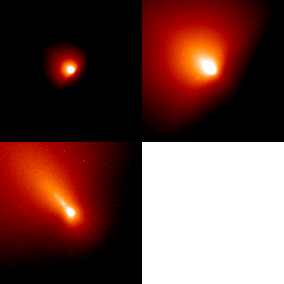
Comet LINEAR (C/1999 S4)
(by Erin Burt)
|
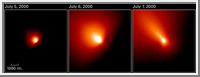
| Pieces of Comet Linear blowing of its crust. [more information] |
The eruption, the comet's equivalent of a volcanic explosion, spewed a great deal of dust into space (even though temperatures are far below freezing, at about minus 100 degrees Fahrenheit in the icy regions of the nucleus of core). This mist of dust reflected sunlight, dramatically increasing the comet's brightness over several hours. Hubble's sharp vision recorded the entire event and even snapped a picture of the chunk of material jettisoned from the nucleus and floating away along the comet's tail. The renegade fragment moved away from the core's weak gravitational grasp at an average speed of about 6 mph.
Scientists have identified several theories for the eruption. One possible reason is that a particularly volatile region of the core became exposed to sunlight for the first time and vaporized suddenly. Another possibility is that a buildup of gas pressure from sublimating ice (a change from ice to gas) trapped just below the comet's surface explosively blew the lid off a pancake-shaped layer of crust from its surface. The pressure from sunlight blew the fragment down the tail. Yet another possibility is that the observed fragment is one of the house-sized "cometesimals" that are thought to make up the nucleus. Evidence accumulated during the past decade suggests that comet nuclei are "rubble piles" of loosely held together cometseimals. Perhaps one of the "building blocks" comprising the core broke off and was blown down the tail by a gaseous jet shooting off the comet's surface like a garden hose spray.
Though comet nuclei have been known to fragment, the view from the Hubble telescope is revealing finer details of how they break apart. This unexpected glimpse at a transitory event may indicate that these types of "Mt. Saint Helens" outbursts occur frequently on the comet.
The orbiting observatory's Space Telescope Imaging Spectograph tracked the streaking comet from July 5 to 7, capturing the leap in brightness and discovering the castaway chunk of material sailing along LINEAR's tail. When the Hubble telescope first spied the comet 74 million miles from Earth, the icy object's brightness rose by about 50 percent in less than four hours. By the next day, the comet was 1/3 less luminous than it was the previous day, and on the final day, the comet was back to normal.
|
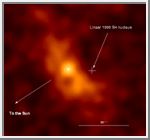
| Chandra X-ray image of X-ray emissions from Comet Linear. [more information] |
Hubble observations of comet LINEAR also measured a deficiency of carbon monoxide compared with other comets, which suggests that the comet origianlly formed much closer to the Sun at temperatures that would have depleted the carbon monoxide. The comet was then tossed out to the Oort cloud, a vast and distant "deep freeze" reservoir of primordial comet nuclei.
Comet LINEAR is named for the observatory that originally discovered it in September 1999. LINEAR is the acronym for Lincoln Near Earth Asteroid Research, a project based in Lexington, Massachusetts.

 Comets